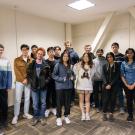
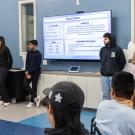
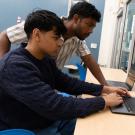
A student-developed and student-led computer science course at UC Davis helped students deepen their practical skills and confidence as they moved from introductory programming to upper-division coursework, research labs and internships.
What if you could talk Shakespeare’s Macbeth out of violence? A new UC Davis-developed game lets players do just that, using AI to simulate dialogue and teach real-world conflict de-escalation skills through interactive storytelling rooted in some of the greatest dramas in the English language.
UC Davis is getting smart about smart tech. With new courses "AI for All" and "AI in Health," the College of Engineering is preparing students across disciplines to explore AI's foundations, applications and ethical impact.
The club at UC Davis has coded its way to compete in the 2025 ICPC North American Championship. Their strategy for success? Practice, teamwork and camaraderie with “fellow nerds.”
In the UC Davis College of Engineering course "Hacking 4 Climate," teams of students tackle real-world environmental issues, from soil health to wildfires to solar energy for all, with an entrepreneurial angle, aiming to find impactful business-based solutions to global problems.
Matt Bishop, a professor of computer science at UC Davis and an expert in cybersecurity, answers a crucial question for the 2024 presidential election in a feature in UC Davis Magazine.
With new internet privacy regulations demanding compliance from data systems, computer science researchers from UC Davis and UC Irvine have partnered with a UC Davis law professor to translate the regulations into technical language. The next step to protecting people's privacy is to build a system that ensures existing systems can comply.
Computer science and engineering student Gautham Pandian is using his experience in software development and artificial intelligence to help educators grade more quickly and students learn more efficiently with a web-based app.
Authoritarian regimes exert control over the internet through transit networks that operate largely out of public view, according to a recent study by researchers in the U.S. and Germany. The work, published in PNAS Nexus, also shows how more sophisticated authoritarian regimes extend their influence by providing network access in poorer but politically similar countries.
After earning his Ph.D. in computer science through the College of Engineering's Distance Learning Program, Kevin Griffin is using his industry knowledge to help the next generation of computer scientists and build a Tulsa-based tech ecosystem from the ground up.