



New Visual Analysis Tool Calms the Climate Data Storm

Climate scientists of today face a conundrum. Their most powerful forecasting tools are overwhelming them with data. Advanced computer models can simulate thousands of possible climate futures: What happens if CO2 emissions stay high? What if environmental policies change — or don’t? How will California’s rainfall patterns shift over the next 80 years?
Each scenario generates massive datasets, and traditional methods for analyzing them, such as averaging and statistical summaries, may miss critical patterns.
“There is a gap between standard statistical techniques that exist in climate science and the vast amount of data being produced,” said Yuya Kawakami, a Ph.D. student in computer science at the University of California, Davis. “Visualization or visual analytics and workflows can be designed to help that, and with climate change imminent, it’s imperative we do this today.”
To address this gap, Kawakami, advised by Professor Kwan-Liu Ma and Assistant Professor Dongyu Liu, both of computer science, developed ClimateSOM, a visual analysis workflow that combines visualization and self-organizing maps to create an interactive interface that helps climate scientists navigate the flood of data and produce more accurate analyses and better predictions. A paper on ClimateSOM was published in IEEE Transactions on Visualization and Computer Graphics.
From Billions of Data Points to Insights
Kawakami came to the climate problem through an unexpected route. While working on a water equity project for California in the Visualization & Interface Design Innovation lab, led by Ma, he met climate scientist Daniel Cayan from Scripps Institution of Oceanography. Kawakami kept pitching ideas to him until one stuck.
"I've always been interested in climate work," Kawakami said. "The appeal of visualization was that it could be applied to actual problems. And there's no problem more pressing or more important to think about than climate change."
Climate models generate so much data because they run different scenarios over 40 to 100 years, adjusting variables such as CO2 emissions, deforestation, urbanization, ocean circulation patterns and potential tipping points. This creates thousands of possible futures that need to be analyzed and compared.
The appeal of visualization is that it can be applied to actual problems. And there's no problem more pressing than climate change." - Yuya Kawakami
Kawakami’s own study used 14 different climate models, each run under four scenarios (historical data plus three emission futures), creating 56 separate projections. Each projection contained roughly 19 million data points. That’s over 1 billion pieces of information to parse, and even that’s a blip in the grand scheme of things. His dataset represents just a fraction of what climate scientists work with globally.
Traditional methods reduce decades of climate data to a single average. It’s like saying that California will get 10% more rain by 2100, but that average could play out in vastly different ways, from steady increases each year to dramatic swings between drought and downpour.
“Averaging data may not be the most accurate way to analyze it,” Kawakami said. “I started thinking, how can I visually encode the distributional nature of things?”
How ClimateSOM Works

A peer of Kawakami’s suggested a self-organizing map, or SOM, a widely used tool in climate science.
A SOM uses machine learning to organize complex data into a 2D grid. Kawakami’s SOM sifted through thousands of precipitation snapshots — maps showing where it’s raining across California at different points in time — and intuitively arranged them on a 2D screen.
This resulted in patterns such as “heavy rain in Northern California, dry in the south” clustering in one region of the grid, and “statewide drought” clustering in another. Scientists can see at a glance which precipitation patterns are most often produced by different climate models.
Kawakami combined this mapping technique with interactive visualization, creating ClimateSOM — a framework that lets scientists explore the full range of climate possibilities rather than collapsing everything into a single average.
The workflow begins by training a self-organizing map on the climate ensemble dataset, creating a grid of nodes that represent distinct spatial patterns. The workflow then follows three main steps.
The first step is “Anchor,” which projects the SOM into a 2D layout. Users, such as climate scientists, can drag and fix the positions of specific SOM nodes. Other SOM nodes can adjust, resulting in an interactive spatial arrangement that is more interpretable than the original SOM grid.
In the second step, “Annotate,” users define bounded regions within the adjusted space and add descriptive labels. A large language model is integrated to help the user; it can provide answers to queries and generate text summaries of selected regions.
With the annotated space established, users can move on to the third “Analyze” step, where they can explore individual climate model runs as distributions, compare models side-by-side and identify clusters of similar model behavior.
In practice, a climate scientist studying California precipitation might anchor wetter climate patterns to the left side of the screen and drier patterns to the right, with a north-south gradient from top to bottom. They might then annotate a region in the upper left as "Wet Sierra Nevada winters." When they run the analysis, they can see which emission scenarios push models into that region and which models behave differently from the rest.
Kawakami views the interactive map as kind of what happens in his own head.
“When I think of very complex things, I try to categorize them and create a sort of mental map,” he said. “I tried to recreate that image as best I could in an interactive system.”
Finding Patterns Traditional Methods Miss
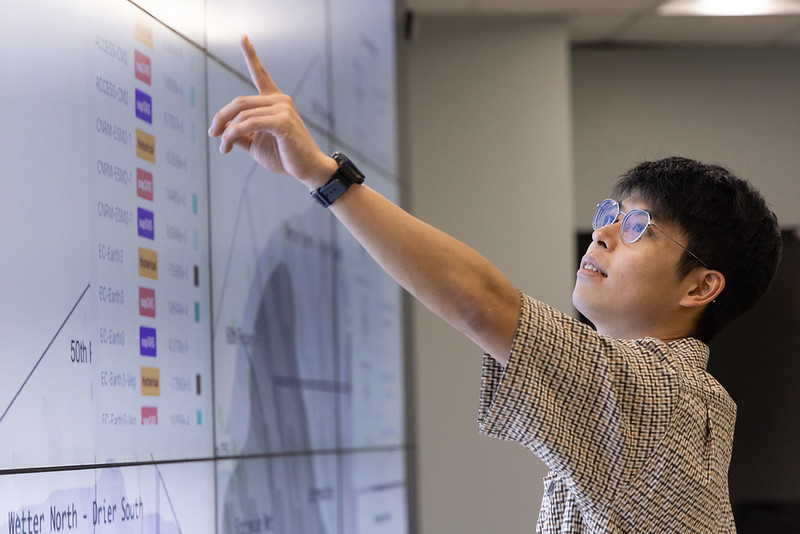
Working with Cayan, Kawakami tested ClimateSOM on precipitation projections for California and the Pacific Northwest. The tool revealed patterns that would be nearly impossible to spot using traditional methods.
For instance, ClimateSOM identified two distinct clusters of climate models predicting California's January precipitation. Models forecasting a wetter January were linked to a specific pattern the previous November: overall dryness with particular aridity in Northern California.
When Kawakami presented the work to climate scientists in Cayan’s network, their response was enthusiastic. One expert noted they had "never seen anything like it before." Another said generating similar insights using their standard methods "would involve generating a very large number of static plots and sifting through them," which could take weeks. ClimateSOM takes minutes.
Kawakami is extending his current work to study precipitation co-variability in the San Francisco Bay-Delta watershed — a crucial watershed that provides drinking water for 25 million people and irrigation for approximately 50% of U.S. produce — and its relationship to the precipitation of the broader West Coast.
Early results from ClimateSOM indicate that this precipitation relationship is changing significantly over time, and that historical trends are increasingly unreliable guides to future climate behavior. Kawakami aims to publish the findings in climate science journals, demonstrating that ClimateSOM generates real insights that advance climate understanding, not just interesting pictures.
As AI-powered climate models become more sophisticated, they’ll produce exponentially more data. Tools like ClimateSOM may become essential for extracting meaningful findings from the flood of information.
“There’s no problem more pressing or more important to think about than climate change,” Kawakami said. “I would encourage anyone who’s interested to pursue this direction, to explore ways to bolster our analysis tech capabilities, especially within climate science, because it’s needed.”